

Building a custom acoustic guitar is not merely an assembly of wood and glue. It is a rigorous discipline that blends centuries-old luthiery traditions with modern precision engineering. According to industry data, the global market for premium musical instruments continues to grow, with collectors and professional musicians increasingly prioritizing tonal uniqueness and build quality over mass-produced alternatives. This guide dissects the intricate journey from raw tonewood to a finished masterpiece, highlighting the expertise found at premier retailers like The Guitar Sanctuary.
The Science of Tonewood Selection
The soul of any custom acoustic guitar lies in its tonewoods. Luthiers do not simply pick wood based on appearance. They evaluate density, stiffness, and internal damping characteristics. The choice of top wood, typically spruce or cedar, dictates the instrument's dynamic range and harmonic complexity.
Adirondack Spruce is renowned for its high stiffness-to-weight ratio. This wood produces a powerful, clear tone with exceptional projection. It is often favored by bluegrass and flatpicking musicians who require immediate response. In contrast, European Spruce offers a more nuanced, complex overtone series. It is preferred for classical and fingerstyle playing where subtlety is paramount.
The back and sides of the guitar provide the tonal foundation. Indian Rosewood is the industry standard for its deep bass response and sparkling highs. However, Madagascar Rosewood has gained significant traction in recent years. Data from recent trade shows indicates a shift toward sustainable alternatives like East Indian Rosewood and Walnut due to CITES regulations. Walnut offers a warmer, more mid-focused tone with excellent sustain. It is an excellent choice for players seeking a balanced, versatile sound.
At The Guitar Sanctuary, the selection process involves hand-tapping each piece of wood. Luthiers listen for the ringing tone to ensure the wood has been properly seasoned and possesses the necessary structural integrity. This meticulous screening ensures that only the finest materials enter the workshop.
Architecting the Bracing Patterns
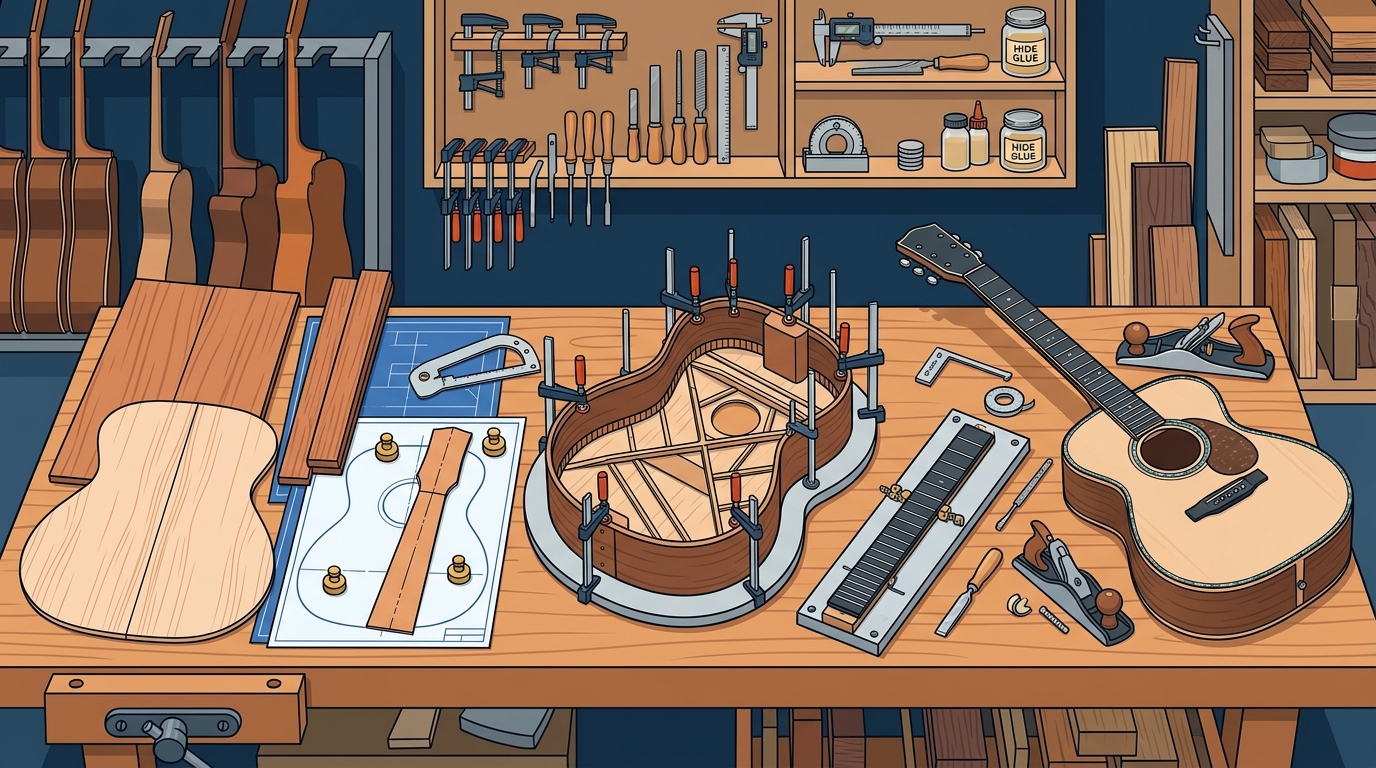
Bracing is the internal skeleton of the guitar. It supports the tension of the strings while allowing the top to vibrate freely. The design of the bracing pattern is the most critical factor in determining the guitar's voice. There is no single correct pattern. Each luthier develops a unique approach based on years of experience and acoustic theory.
X-Bracing is the most common pattern for steel-string acoustics. It was popularized by C.F. Martin & Company in the 19th century. The X-shape provides a strong center support while allowing the outer edges of the top to vibrate. This design creates a balanced tone with strong bass and treble response.
Scalloped Bracing involves carving away material from the top of the braces. This reduces the weight of the bracing system, allowing the top to move more freely. The result is a guitar with greater volume and responsiveness. However, it requires precise calculation to avoid structural failure. Over-scalloping can lead to a weak, flabby tone. Under-scalloping can result in a stiff, unresponsive instrument.
Other patterns include fan bracing, which is standard for classical guitars. This pattern radiates from the soundhole outward, providing a warm, rounded tone. Parabolic bracing is a more modern approach. It varies the thickness of the braces along their length to optimize vibration modes. This technique is often used in high-end custom builds to achieve a specific tonal target.
The luthier must also consider the tone bar and tail block. These components transfer the string tension to the body. Their placement and dimensions are calculated to ensure structural stability without compromising tonal quality. The goal is to create a system that is both strong and resonant.
The Assembly and Glue-Up Phase
Once the bracing is carved and shaped, the assembly phase begins. This is a delicate process that requires steady hands and a keen eye for detail. The first step is to attach the bracing to the top. Luthiers use hide glue, which is reversible with heat and moisture. This allows for future repairs and adjustments.
The top is then curved using a bending iron and heat. This process, known as arching, adds strength to the top and influences the tonal character. A higher arch generally results in a louder, more powerful guitar. A lower arch produces a more responsive, nuanced instrument. The luthier must balance these factors to achieve the desired sound.
The sides are bent using a hot iron and bending form. The wood is softened by heat and moisture, allowing it to conform to the mold. Once cooled, the sides retain their shape. The linings are then glued to the inside of the sides. These strips provide a surface for the top and back to be attached.
The neck joint is a critical component. It must be precise to ensure proper intonation and playability. Common joint types include the dovetail and the scarf joint. The dovetail joint is traditional and allows for easy adjustment of the neck angle. The scarf joint is stronger and is often used in modern builds. The choice of joint depends on the luthier's preference and the guitar's design.
At The Guitar Sanctuary, the assembly process is overseen by master luthiers who have decades of experience. They ensure that every joint is tight and every curve is smooth. This attention to detail is what separates a custom guitar from a mass-produced instrument.
Finishing and Curing Protocols
The finish protects the wood and enhances its appearance. However, it also affects the tone. A thick finish can dampen the vibration of the top. A thin finish allows the wood to resonate more freely. Luthiers must choose a finish that balances protection with tonal transparency.
Nitrocellulose Lacquer is the traditional finish for high-end guitars. It is thin, durable, and ages beautifully. Over time, it checks and cracks, giving the guitar a vintage look. It is also easy to repair. However, it is sensitive to heat and chemicals. It requires careful handling during the finishing process.
Shellac is another traditional finish. It is applied in thin layers and polished to a high gloss. It is known for its warm, rich tone. It is also easy to repair. However, it is less durable than nitrocellulose lacquer. It is sensitive to water and alcohol.
Polyurethane is a modern finish. It is thick, durable, and resistant to heat and chemicals. It is often used on mass-produced guitars. However, it can dampen the tone of the instrument. It is less desirable for high-end custom builds.
The finishing process involves multiple stages. The wood is sanded smooth, then the finish is applied in thin layers. Each layer is allowed to cure before the next is applied. The final layer is polished to a high gloss. This process can take weeks or even months to complete.
At The Guitar Sanctuary, the finishing is done in a controlled environment. Temperature and humidity are carefully monitored to ensure the finish cures properly. This ensures a flawless, durable finish that enhances the guitar's beauty and tone.
Final Setup and Playability
The final stage of the building process is the setup. This involves adjusting the neck, bridge, and nut to ensure optimal playability. The action, or string height, is adjusted to balance comfort and tone. A lower action is easier to play but can cause fret buzz. A higher action provides more volume and sustain but can be harder to play.
The intonation is checked and adjusted. This ensures that the guitar plays in tune all the way up the neck. The neck relief is adjusted using the truss rod. This ensures that the neck is straight and the strings vibrate freely.
The nut and saddle are filed to the correct height. This ensures that the strings are at the proper distance from the fretboard. The string spacing is also adjusted to match the player's preference.
At The Guitar Sanctuary, the setup is performed by experienced technicians who understand the nuances of high-end instruments. They ensure that every guitar leaves the workshop in perfect playing condition. This includes a thorough inspection of the finish, hardware, and electronics.
Key Takeaways
- Tonewood Selection: The choice of spruce, cedar, rosewood, or walnut fundamentally dictates the guitar's tonal character and dynamic range.
- Bracing Architecture: Scalloped X-bracing is a critical technique for maximizing top vibration and volume in custom builds.
- Hide Glue Usage: Traditional luthiers use reversible hide glue to allow for future repairs and maintain structural integrity.
- Finish Impact: Nitrocellulose lacquer is preferred for its thin profile, which minimizes tonal dampening compared to polyurethane.
- Neck Joint Precision: The dovetail and scarf joints are standard methods for ensuring stable neck angle and intonation.
- Setup Importance: Final action, intonation, and neck relief adjustments are essential for optimal playability and tone.
- Expert Oversight: Visiting a specialized retailer like The Guitar Sanctuary ensures access to master-crafted instruments.
Frequently Asked Questions
What is the difference between a custom and a production acoustic guitar?
A custom acoustic guitar is built to specific specifications for an individual player. It involves hand-selected tonewoods and meticulous craftsmanship. A production guitar is mass-produced using standardized parts and processes. Custom guitars offer superior tonal quality and unique aesthetics.
How long does it take to build a custom acoustic guitar?
The process typically takes several months. This includes the time for wood seasoning, carving, assembly, and finishing. The curing time for finishes like nitrocellulose lacquer can extend the timeline significantly. Patience is required to ensure the instrument performs at its best.
Why is hide glue used instead of synthetic glue?
Hide glue is reversible with heat and moisture. This allows luthiers to disassemble the guitar for future repairs. Synthetic glues are permanent and can damage the wood during disassembly. Hide glue also has a slight flexibility that can enhance the tonal response.
What is the best wood for a custom acoustic guitar top?
Adirondack spruce and European spruce are the most popular choices. Adirondack spruce offers a powerful, clear tone with strong projection. European spruce provides a more nuanced, complex overtone series. The best choice depends on the player's style and tonal preference.
How does bracing affect the sound of a guitar?
Bracing supports the top and influences its vibration modes. Scalloped bracing reduces weight and increases responsiveness. Heavier bracing creates a louder, more powerful tone. The pattern and thickness of the braces are critical in determining the guitar's voice.
What is the role of the soundhole rosette?
The rosette is a decorative inlay around the soundhole. It protects the edge of the top from wear and tear. It also adds aesthetic value to the instrument. The design of the rosette can reflect the luthier's style and the guitar's overall theme.
Can a custom guitar be modified after purchase?
Minor modifications are possible, such as adjusting the action or intonation. Major modifications, such as changing the bracing or top wood, are not feasible. It is important to choose the right specifications during the building process. Consult with a luthier for any potential changes.
Experience Master Craftsmanship
The journey to finding the perfect custom acoustic guitar requires expertise and access to the finest instruments. The Guitar Sanctuary offers a curated collection of boutique guitars, amps, and pedals. Their team of experts is dedicated to helping you find the instrument that matches your unique musical voice. Visit their store or contact them online to begin your journey.