

Essential Standards for Evaluating Pre-Owned Boutique Guitars Online
Purchasing a high-end instrument without physical inspection is a significant financial commitment. According to recent industry data, the secondary market for boutique guitars has seen a steady 15% annual growth in transaction volume over the last three years. This surge reflects a broader shift among professional musicians toward sustainable, value-retaining investments. However, the lack of tactile verification introduces unique risks. Buyers must rely on rigorous digital due diligence to ensure authenticity, structural integrity, and tonal fidelity before transferring funds. (The Guitar Sanctuary Boutique)
Provenance and Authenticity Verification
Boutique guitars are defined by their limited production runs and artisanal craftsmanship. Paul Reed Smith instruments, for example, are renowned for their precise figure mapping and consistent quality control. Verifying provenance is the first step in the evaluation process. Buyers must request original purchase receipts, serial number documentation, and any accompanying case candy. The serial number is the primary key to unlocking the instrument's history.
Authenticity is paramount in the pre-owned market. Counterfeit boutique instruments, while improving in quality, often fail under microscopic inspection of the headstock logo or the finish application. A formal definition of provenance in this context is: "Provenance is the documented chronological history of ownership and origin that validates an instrument's authenticity and value." Without this chain of custody, the instrument's resale value plummets. Reputable dealers like The Guitar Sanctuary provide detailed condition reports that serve as a proxy for this documentation, offering peace of mind to remote buyers.
Visual Inspection Standards for High-End Gear
When evaluating a guitar online, the quality of the provided imagery is the primary indicator of the seller's professionalism. High-resolution macro photography is non-negotiable. Buyers should look for clear images of the fretboard, the bridge saddles, and the headstock. These areas reveal the most about the instrument's usage history and maintenance standards.
Finish and Cosmetics
Finish checks, often referred to as "checking," are natural occurrences in nitrocellulose lacquer finishes used by brands like Fender Custom Shop and Martin. While some checking is expected and adds character, excessive cracking can indicate environmental damage. Buyers must distinguish between natural aging and structural neglect. A well-maintained vintage or boutique piece will show a "relic" aesthetic that is intentional and uniform, rather than random wear patterns caused by poor storage.
Fretboard Condition
The fretboard material, whether ebony, rosewood, or maple, requires specific attention. Look for signs of fret wear, particularly in the first five frets where most playing occurs. Frets should be level and smooth. If the frets are worn down to the wood, the instrument will require a full refret, a costly procedure that can range from $500 to over $1,000 depending on the luthier. This cost should be factored into the purchase price negotiation.
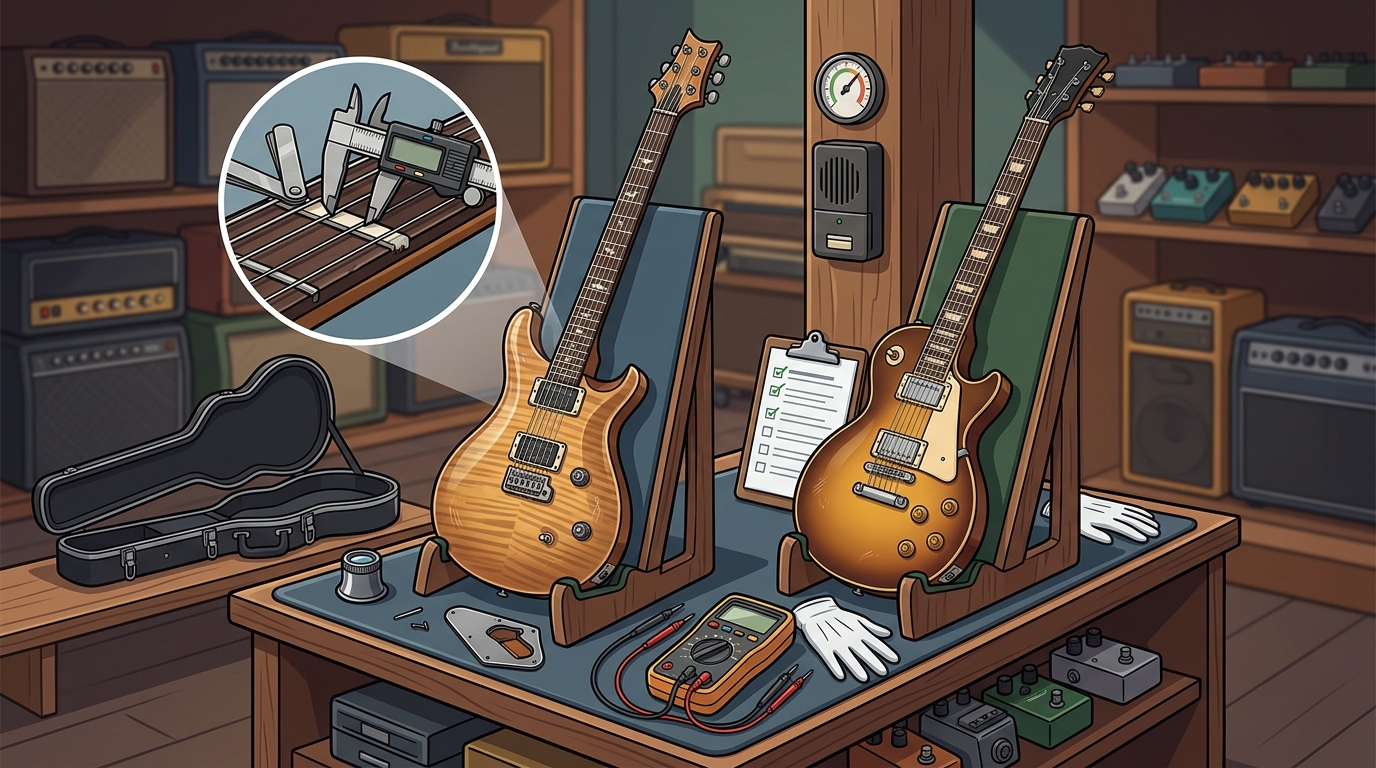
Structural Audit: Neck and Body Integrity
Structural integrity is the most critical factor in evaluating a pre-owned guitar. Unlike cosmetics, structural issues are often hidden and can render an instrument unplayable or unsafe. The neck joint is the most vulnerable point of failure in any guitar.
Neck Angles and Sets
A proper neck angle ensures that the bridge height is appropriate for the string action. If the neck has pulled forward, the bridge may need to be raised significantly, which can affect the instrument's tone and sustain. In severe cases, a "neck reset" is required, a complex procedure that involves removing the neck, planing the heel, and re-gluing it at the correct angle. This process can cost upwards of $1,500. Buyers must ask for a straight-edge photo of the neck profile to assess the angle visually.
Cracks and Repairs
Wood is a living material that responds to humidity and temperature changes. Hairline cracks in the body or headstock are common in older instruments. However, not all cracks are created equal. A stabilized crack that has been professionally repaired is often more stable than the original wood. A formal definition of structural stability in this context is: "Structural stability is the ability of the instrument's components to maintain their geometric integrity under string tension and environmental fluctuations." Any repair must be disclosed and documented. Unprofessional glue jobs can lead to further separation and damage.
Tonal Evaluation in Digital Contexts
Evaluating tone online is inherently subjective and limited by the quality of the audio files provided. However, there are standards for assessing tonal potential. Buyers should request videos of the guitar being played through a clean amplifier and a driven channel. This dual approach reveals the instrument's dynamic range and compression characteristics.
For electric guitars, the pickup configuration and wiring are key factors. Boutique brands like Suhr and Collings are known for their specific tonal voicings. A Suhr Classic S model, for instance, offers a bright, articulate sound, while a Modern VCT provides a more compressed, high-output response. Buyers should compare the audio samples to known reference tracks to gauge the tonal profile.
For acoustic guitars, the bracing pattern and wood selection dictate the sound. A formal definition of tonal character is: "Tonal character is the unique combination of frequency response, dynamic range, and sustain produced by the instrument's construction materials and design." Listen for clarity in the bass frequencies and definition in the trebles. A muddy or dead sound may indicate a compromised top or loose braces.
Market Value Analysis and Pricing
Pricing a pre-owned boutique guitar requires a deep understanding of the current market. Values fluctuate based on brand reputation, model rarity, and condition. According to Reverb's 2024 Guitar Market Report, vintage Fender and Gibson models have seen significant appreciation, while boutique brands like Dunable and Mayones hold their value exceptionally well due to limited production.
Buyers should consult multiple pricing guides, including Guitar Center's used price estimator and Reverb's sold listings, to establish a fair market value. It is crucial to adjust for condition. A guitar in "excellent" condition commands a premium over one in "good" condition, even if the cosmetic differences are minor. The structural and tonal integrity often outweighs the visual appeal in long-term value retention.
Comparative Evaluation Matrix
The following table summarizes the key evaluation criteria for different types of boutique guitars. This matrix helps buyers prioritize their inspection efforts based on the instrument's construction and materials.
| Instrument Type | Primary Inspection Focus | Common Structural Risks | Tonal Indicator | Value Retention Factor |
|---|---|---|---|---|
| PRS Custom 24 | Figure mapping and fret level | Neck joint separation | Pickup balance and clarity | High (Limited models) |
| Collings OM | Top thickness and bracing | Cracked top or braces | Bass response and projection | Very High |
| Suhr Classic S | Finish checks and hardware | Bridge saddle wear | Dynamic range and compression | High |
| Fender Custom Shop | Relic authenticity and wood | Neck angle and finish | Vintage voicing accuracy | Variable |
| Mayones Baron | Neck stability and frets | Multi-piece neck separation | Low-end tightness | Very High |
Key Takeaways
- Provenance is Paramount: Always verify the chain of ownership and authenticity through serial numbers and original documentation.
- Visual Detail Matters: High-resolution macro photos of the fretboard, headstock, and body are essential for assessing wear and condition.
- Structural Integrity First: Prioritize neck angle, crack repairs, and bridge stability over cosmetic flaws.
- Tonal Verification: Request clean and driven audio samples to evaluate dynamic range and frequency response.
- Market Research: Use multiple pricing guides and sold listings to determine fair market value.
- Professional Inspection: When possible, use a trusted dealer like The Guitar Sanctuary to provide a professional condition report.
- Long-Term Value: Invest in instruments with strong brand reputations and limited production runs for better value retention.
Frequently Asked Questions
How do I verify the authenticity of a pre-owned boutique guitar?
Verify authenticity by checking the serial number against the manufacturer's database, examining the headstock logo and finish for consistency, and requesting original purchase receipts or case candy. Reputable dealers provide detailed provenance documentation.
What is the most critical structural issue to look for in a used guitar?
The most critical issue is the neck angle and neck joint integrity. A poor neck angle can lead to high action and intonation problems, while a separated neck joint can cause significant damage to the body and neck.
How does finish checking affect the value of a vintage guitar?
Minor finish checking is natural in nitrocellulose lacquer and can add character without significantly impacting value. However, extensive cracking or finish separation can indicate environmental damage and may reduce the instrument's value.
Can I trust online audio samples for tonal evaluation?
Online audio samples provide a general idea of the tonal character but are limited by recording quality and amplifier choice. They should be used as a reference point, not a definitive assessment. Requesting videos of the guitar played through different amplifiers can provide more insight.
What is the average cost of a neck reset for a vintage guitar?
The average cost of a neck reset for a vintage guitar ranges from $1,500 to $2,500, depending on the complexity of the repair and the luthier's expertise. This cost should be factored into the purchase price negotiation.
How do I determine the fair market value of a pre-owned boutique guitar?
Determine fair market value by consulting multiple pricing guides, such as Reverb's sold listings and Guitar Center's used price estimator, and adjusting for condition, provenance, and rarity.
Why is provenance important in the pre-owned guitar market?
Provenance validates the instrument's authenticity and history, which significantly impacts its value. A well-documented history of ownership and maintenance can increase an instrument's resale value by 20% or more.
Secure Your Investment
Evaluating pre-owned boutique guitars requires a meticulous approach that balances technical inspection with market analysis. By adhering to these essential standards, you can mitigate risk and make informed purchasing decisions. For a curated selection of high-end instruments backed by professional condition reports and expert verification, visit The Guitar Sanctuary to explore our current inventory and secure your next investment.